Tag Archives: Resurrection

Mortal Remains

I just recorded a bunch of songs about death. Why? Fr. John Behr, Regius Professor of Humanity at the University of Aberdeen, has often remarked on how the biggest societal change in modern times has not been the invention of electric lights, air travel, or even the internet, but the fact that our way of dealing with death has been so drastically altered—the “disappearance of death,” he calls it.

By the ‘disappearance’ of death, I do not of course mean that we no longer die, but rather the troubling eradication of the presence of the dying and the dead from our living space. Instead of death happening at home, with the dying one cared for by family and neighbors, who then tend to her or his body till she or he can be commended to God and entrusted to the earth, death has now become largely consigned to the hospital, where ‘life’ is preserved as long as possible, and when it becomes unfeasible the ‘life-support’ machine is switched off, with the family allowed a brief period of mourning with the corpse before it is handed over to the mortician, culminating in a ceremony at which the corpse is increasingly not present (having already been disposed of) but the past ‘life’ of the departed celebrated. In a very real sense, we today live as hedonists (as if this life in the body as we know it is what it is all about) and die as Platonists (the chains of the body now being removed and disposed of, so that we can, unfettered by the reality of the corpse, celebrate the past ‘life’ of the person), all of which displays a very ambiguous attitude towards our embodiment. It would not be an exaggeration to say that this is the greatest change in the history of the human race: everyone, everywhere, from time immemorial had to deal with death in an immediate, familial, manner until its industrialization over the course of the twentieth century.

Continue reading

The Assumption of Mary

Maria est assumpta

Why do the Roman Catholic and Orthodox churches celebrate the assumption of Mary? It turns out, it’s because of Easter.

But Easter has to do with Jesus, and this feast day is about Mary, right? As with all celebrations of the Saints, of course, it’s Jesus who shines through them to receive the highest and ultimate praise. When we depict the Saints in our iconography, they have a halo around their heads; that halo is the light of Christ shining out of them. They have surrendered their old life, the mere life of bios—biological life—in exchange for zoe, the divine life that is God himself, united to human nature in Jesus Christ, and shared now with all his brothers and sisters, if they will receive it. Those who shine through with that light most brilliantly, who have evidenced to the Church that their lives are full of the Christ-life, we call Saints.

And so a feast day for a Saint is never really just about that Saint. It’s always about Christ who that Saint conforms to. There are some Christians who think of the Kingdom of heaven as a zero sum game, where any praise a Saint gets is praise that God isn’t getting. But that’s not how the Kingdom works at all. Christ glories in his Saints, and his Saints glory in him. Christ’s glory is not diminished when we celebrate those who belong to him; just the opposite—his glory increases. And so let’s look to Mary, and see how she increases her Son’s glory. Continue reading

The Truth Of Easter

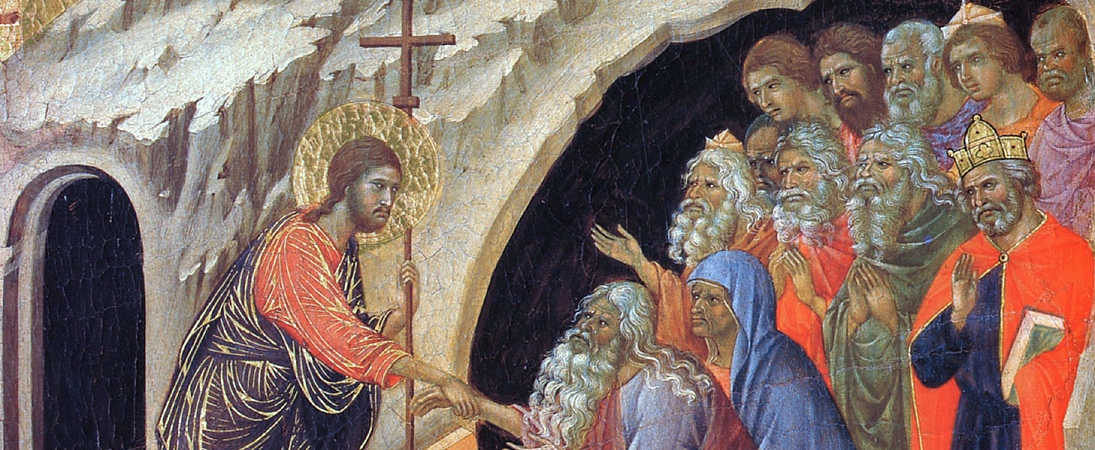
Christ delivering Adam, Eve, and other righteous souls in prison (1 Pet. 3:19, 4:6).

Christ delivering Adam, Eve, and other righteous souls in prison (1 Pet. 3:19, 4:6).

The most famous sermon ever preached in Christian history has to be the one given by St. Peter to the multitude on Pentecost, as recorded in the second chapter of the Acts of the Apostles. The second most famous sermon, however, must be one given three hundred years later by St. John Chrysostom on Pascha (Easter) morning at the great midnight vigil. But St. John’s sermon has the distinction of enjoying an ongoing career as a living homily still preached every Easter in hundreds, probably thousands, of churches across the world at their midnight vigils. The words of the homily are timeless and universal, and they magnificently describe the truth of Easter: Continue reading

Reflection On Lent And Pascha

After observing Lent, and especially the last days of Holy Week, it’s absolutely amazing how exciting the arrival of Easter is. At The Advent, we had a service every night of Holy Week, including a vigil at 11:30 Saturday night in order to celebrate the Resurrection literally first thing in the morning. By the time of our vigil, the mounting anticipation was intense. I was weary from fasting and annoyed at my own shortcomings that the fast had revealed. The powerful Good Friday service the day before had forced me to experience our Lord’s death in new ways. The fact that Saturday itself is part of Holy Week — the fact that I had to observe it too, to think about Jesus’ cold body lying in the dark on a slab, me hiding uncomfortably with the scattered disciples — made me want to jump ahead to the resurrection I knew about from history. The emotions that kept bubbling up didn’t match my circumstances, like when a sad dream affects the tone of the next day. Continue reading

The Pregnant Forty

Storm_clouds
I just finished reading a book by Eugene Peterson called Under the Unpredictable Plant. In the book, Peterson uses the Jonah story to discuss the vocation of pastoral ministry. He’s really spectacular at drawing meaningful parallels from Jonah’s behavior, psychology, and circumstances to the life of a pastor, and often more broadly, to Christians’ lives. One example is his expounding of the message Jonah was sent to prophesy: “Yet forty days, and Nineveh shall be overthrown.” To the ears not rooted in ancient near-eastern culture, the ears not familiar with biblical prophecy, the ears boastful of hearing what they’ve been fed yet condescending toward what they haven’t – my ears, our ears – to those ears, a prophecy like that sounds like some malevolent Zeusonian lightening bolt kind of hogwash. To the city of Nineveh, we are told, which didn’t have our ears, this prophecy sounded like an alarm. Not sounding the imminent destruction of a city full of innocent people, but a warning meant to steer a wayward ship away from the deadly rocks. Nineveh heard “forty days” and threw the ship hard to starboard… or port. They repented, fasted, and resolved to change their ways because in the declaration “forty days,” they heard “hope.” Continue reading