
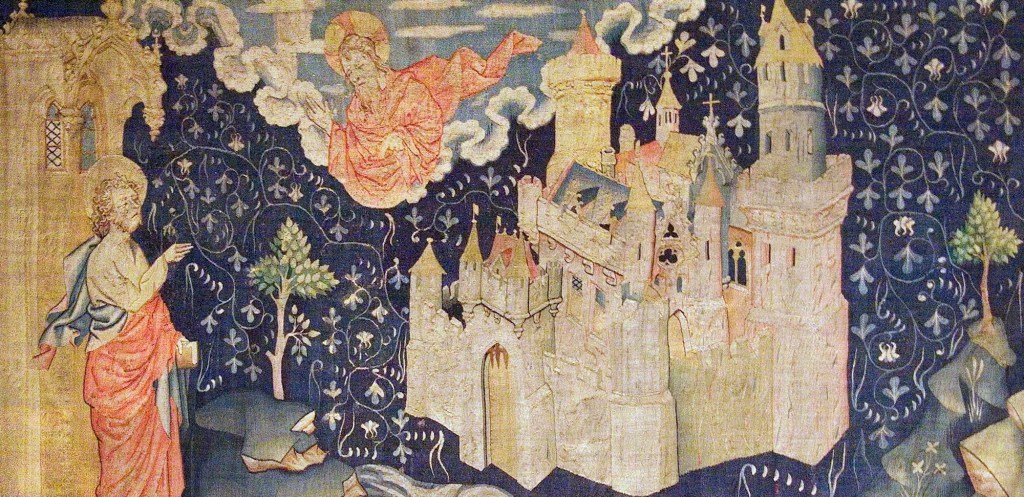
“And the gates of that city shall not be shut at all by day: for there shall be no night there.” Apoc. 21:25
“Jesum Christum, quem oportet quidem caelum suscipere usque in tempora restitutionis omnium…” Actus 3:21
When I started this blog fifteen years ago, I had just been getting used to a new concept that, for me, felt like it not only made everything I knew and believed cohere together as never before, but also gave me an almost mystically altered perspective on reality. The idea of everything being part of one huge all-encompassing narrative, a meandering yet structured story, changed the way I thought of history, philosophy, and theology. Since then, in the intervening years, I’ve been growing more and more convinced and convicted about an extremely important aspect of our one world story, and I’ve been wanting to get my thoughts about it written down. My thoughts are of course really other peoples’ thoughts, which I’ve read and listened to and digested and weighed internally against everything else that’s in my mind and heart, and finally assented to and owned, I hope with logic and humility, to make them my own.
The problem of evil in Creation is the most reasonable challenge to Christianity and its doctrine that God is all-Good, all-Knowing, and all-Powerful. If God is each of those, then why do evil things happen and creatures experience pain? No doubt some of the pain we all experience is the result of our own actions—pains which we’ve brought upon ourselves. But not every evil visited upon us is our own doing.
Natural evils are everywhere: sicknesses and poverty; tsunamis and earthquakes and blizzards that wipe out infants and the elderly; and countless other afflictions of nature. Then there are all the acts of evil perpetrated by people onto others: gang violence; systematic oppression of the poor by the rich; the atrocities of war and genocide through the centuries. How or why has God allowed all of these evils?
Is it that God is not, after all, simultaneously all-Good (omnibenevolent), all-Knowing (omniscient), and all-Powerful (omnipotent)? Does God not posses all three of the “omnis”? For God to be all-Powerful without being all-Knowing seems to me contradictory on its face, as having every power entails having (the power of) perfect and complete knowledge. For God to have perfect knowledge and power but not to be entirely Good doesn’t so much solve the problem of evil as it raises the problem of good: why is there good at all, how do we recognize it, and how can we conceive of perfect goodness? For God to be perfectly good and entirely knowledgeable without having total power to enact his will, however… that notion seems less contradictory initially, and has been in part explored in systems like the dualism of Zoroastrianism and (as C.S. Lewis opined) the manly but doomed battle of Odin against the frost giants and Jörmungandr. Even in the early Hebrew scriptures and many of the Psalms, there seems to be an implication that, even though YHWH is master over the whole cosmos and of every power within it, death and Sheol still lay beyond his scope of action (Ps. 6:5; Ps. 30:9; Ps. 88:10).
By the time of Jesus, however, in the second-temple Jewish period and certainly in the New Testament after his death and resurrection, it was realized that, yes, of course YHWH has power over death and Sheol. Since God is the creator of all, nothing is beyond his power. He can make dry bones to live again. He can put away the order of the cosmos like an old garment and make a new one, without losing anything worth keeping. And importantly, he can lay down and then take up again his own incarnate, human life. The Resurrection of Jesus of Nazareth has revealed the pattern of God’s redemptive work: rescue and re-creation to radical newness, yet with continuity to the old. And not just that which was good of the old, but also the bad, only transformed: the scars of pain gained by self-sacrifice are retained as badges of glory in the hands, feet, and side of Jesus, and in the wounds of his Martyr-Saints. This is a huge clue to the plans and purposes of God in the end.
If the pain caused by evil can be turned into rewards, honors, treasures, and glories, then they have a reason and a purpose for being allowed to exist for a time. God is of course not the maker of evil or pain, but, having created a world from nothing and knowing that within it pain would become possible in part due to the uninhibited choices and actions of his finite and fallible creatures, God must yet have deemed this reality worth allowing for a time. Why? Because there must be certain blessings and glories which could never arise or be brought about except through the redeeming and transforming of former pains. There must be goods which could never have gotten their unique character without having been first transformed from evils. A journey through the mire makes the ascent upwards beyond it that much more beautiful. Instead of thinking of Creation as a static good that has been marred and must—as if in a plan B—be rescued and reset, maybe Creation was always more like a story which was going to require its villains and drama and plot twists in order to be brought to a glorious conclusion: the ultimate “happily ever after.”
If we think about Creation as a narrative, then nothing has to be wasted or forgotten about or written off as unimportant. All of our pain and suffering is taken into account and can be woven into its own very specific and particular redemptive transformation. And the glory it will be turned into is beyond comparison to how bad it seems now (“the sufferings of this present time are not worthy to be compared with the glory which shall be revealed in us“).
So God can be all-Good, all-Knowing, and all-Powerful as long as he is only allowing the pain and evil for a few chapters of our story in order to subvert them and transform them into their correlated but abundantly more powerful rewards and honors in the final chapter(s).
What’s more, if God is truly omnibenevolent, omniscient, and omnipotent, then this Creation he has brought into existence from nothing (or rather from himself, as creatio ex nihilo is really creatio ex Deo) is known to him in its entirety—from beginning to end—from before it came to be, and was judged by him to be not only worth it, but good. Very good. We know of at least two types of creatures in this Creation which are capable of moral reason and inter-personal relationship: human beings and spiritual/angelic beings. And if the God of perfect goodness, power, and love brought each of these creatures into existence, knowing this act to be very good, then he has foreseen (or rather simply sees) the totality of each of these creatures’ lives, from beginning through the entirety of their immortal and everlasting endurance. God has seen each path and each end/telos and lovingly brought each human or angel into existence… from love and for love. So would perfect Love bestow existence on a creature if that creature’s ultimate end was anything but very good? Would perfect Love begin a story knowing full well it would end in pain, misery, hatred, and darkness?
The ultimate question, maybe behind all of our questions in life, is this: does it make sense that God would bring us or any persons into existence knowing we would reject him and our own existence and end up in a final state of suffering or non-existence?
Most Christians would probably answer that God wouldn’t want that, but that the loss of some creatures would always be a possibility because of their free will. God would have to just take that chance. Of course, because we’re finite, we can imagine God taking a chance like that, of judging a system as good “on balance”, while taking into account “acceptable losses.” We operate this way all the time. But God is not finite. There are no limitations on the perfect workings of God’s goodness, knowledge, and power. So, having no limitations, God would only create a world in which he knew that he could bring about salvation for all people, because God can do all things… all things that are logically and intrinsically possible, that is.
C.S. Lewis wrote in The Problem of Pain: “[God’s] Omnipotence means power to do all that is intrinsically possible, not to do the intrinsically impossible. . . because nonsense remains nonsense even when we talk it about God.” So to say that God must be able to create a square circle since “God can do all things” is still nonsense, because “intrinsic impossibilities are not things but nonentities.” So is it intrinsically possible that God could save everyone without violating their free will, say, through unarguable reason and an undreamt of vision of compelling beauty that stirs the deepest and most fundamental desire for God even in the most wicked and rebellious of his creatures? Of course it’s intrinsically possible. Therefore, God could do it. Therefore God would do it.
I think we could go further and say that not only is this scenario intrinsically possible, but the alternate scenario of creatures being lost forever who were created for loving relationship with God may actually be intrinsically impossible. Why? Look again at God’s triple characteristics of being omnipotent, omniscient, and omnibenevolent, and think of scenarios that would violate them and would be intrinsically impossible according to each. For example, God cannot create a rock he could not lift as that would make nonsense of his omnipotence; he could not invent a riddle so difficult that he couldn’t solve it as that would make nonsense of his omniscience; so likewise God cannot create a person in whom his love was not fulfilled because that would make nonsense of his omnibenevolence. The God who is absolute, unbounded, and limitless Love would never have made a world in which one of his children would be lost to him. Simply not to create would be the omnibenevolent option were there ever even the chance of not being able to redeem even one of his children.
I’m going to be writing more about this, fleshing out these points, beginning in Part 2 with how God wouldn’t violate the free will of his creatures, even as redeeming the most rebellious of them. I’m doing this knowing that this is a minority position among Christians, and that some Christians, even clergy in my own communion of the Orthodox Church, think this is a heresy. I obviously disagree, and I’ll address that too.
Pray for me, a sinner.
 One World Story
Pingback: Restitutio Omnium, Part 2: The Freeing of Free Will | One World Story